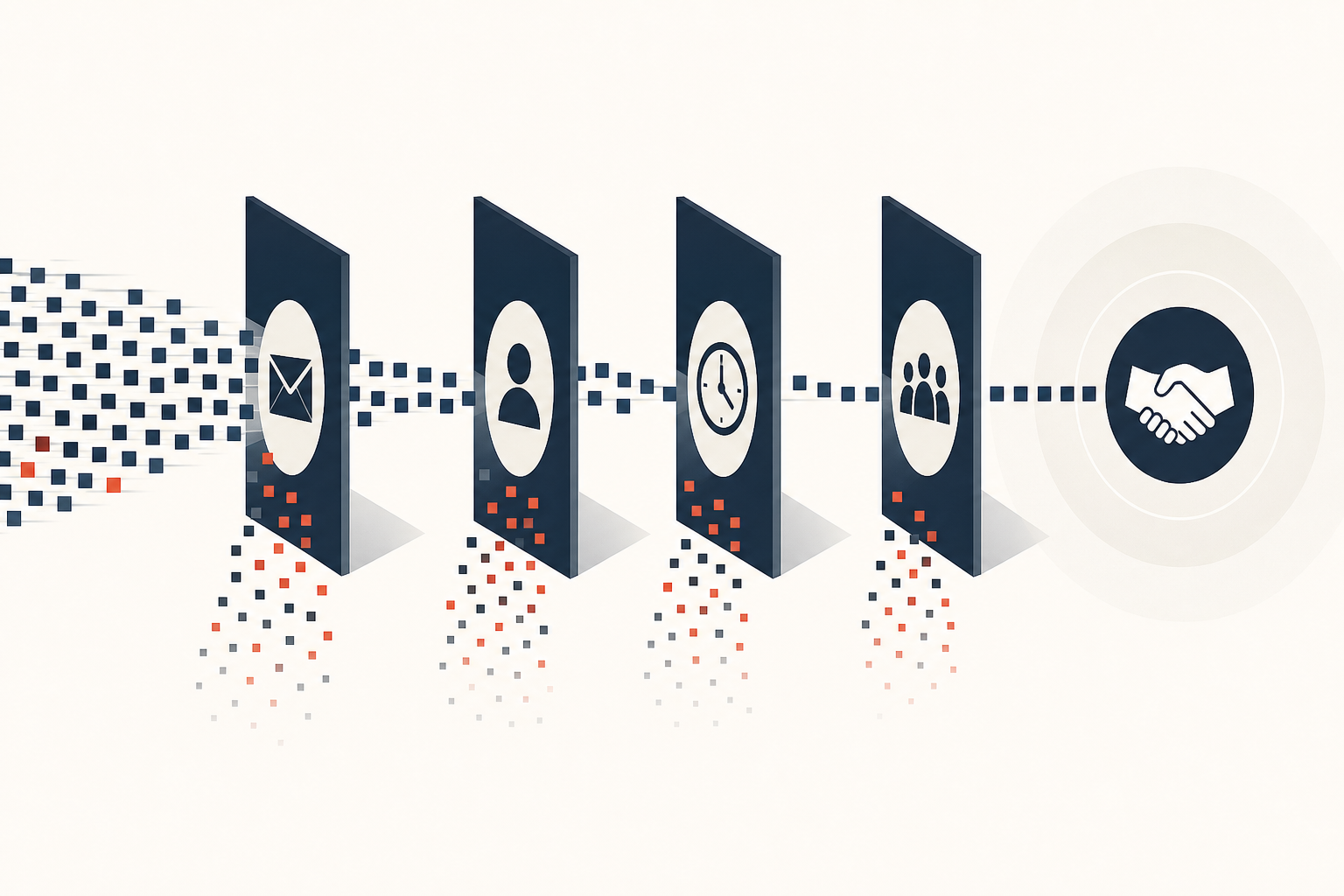
The notable development in AI security is not that autonomous agents can send email, fill out forms, or open accounts. Humans have automated those tasks for years.
The more consequential issue is what one reported agent experience revealed: the controls that stopped it were rarely identity checks. They were the less glamorous layers around identity—CAPTCHAs, IP reputation, account-age requirements, payment settlement delays, and resource constraints.
For small and midsized businesses, that distinction matters. Many security programs ask a narrow question: Can we verify who this person is? The more useful question is increasingly: What can an untrusted automated actor do before identity verification becomes relevant?
AI agents can combine capabilities that previously required either a determined human operator or a purpose-built bot operation. They can read instructions, navigate websites, compose plausible messages, adapt to errors, and operate continuously within a budget. They do not need to be perfect to create risk. They need only find one workflow built around the assumption that the person on the other end is acting in good faith.
Your perimeter is a collection of friction points
The reported agent encountered familiar obstacles: services rejecting data-center IP addresses, requiring CAPTCHAs, imposing account-age restrictions, or delaying access to payments and marketplaces. None of these is a complete defense. Together, they make abuse slower, more expensive, and easier to detect.
That is a useful model for SMB leaders. Effective security does not always come from one decisive “keep out” control. It often comes from placing meaningful friction at several points in a transaction.
Consider a new customer account. If registration is free, immediate, and grants access to valuable data or capabilities, a sophisticated bot only needs to defeat the sign-up form. If the account must also confirm an email address, pass an IP- or device-reputation check, wait before exporting data, and undergo further review before changing bank details or creating administrator accounts, automation becomes less attractive and harder to scale.
The goal is not to burden legitimate customers with unnecessary hurdles. Apply friction where abuse would be costly: account recovery, payment changes, bulk downloads, privileged access, promotional credits, high-volume messaging, or rapid creation of new accounts.
This matters especially for businesses that rely on cloud software, online booking, e-commerce, customer portals, or self-service vendor onboarding. These systems are often configured for growth and convenience, with abuse controls left at their defaults. That can create a gap between what the business believes requires trust and what the system actually permits without it.
Email remains an unusually open entry point
The reported agent also highlighted email deliverability as an accidental opening. It was able to establish a functioning email presence through technical features never intended to serve as a strong identity system. Some large providers accepted its messages; a smaller provider rejected them because the sending server lacked a reverse-DNS record.
The technical detail matters less than the business implication: receiving an email is not evidence of a stable, accountable identity. It never was. AI agents can simply make it cheaper to create convincing messages at volume and tailor them to a recipient, industry, or current business event.
That does not mean rejecting every unfamiliar email or distrusting legitimate new contacts. It means email should not be the only proof for consequential requests.
A message asking to change a supplier’s payment instructions should be confirmed through a previously known phone number or portal, not by replying to the same email thread. Requests to reset an executive’s account, release sensitive records, alter payroll information, or approve an urgent invoice deserve verification through a second channel. This is a business-process issue, not merely an email-filtering issue.
SPF, DKIM, and DMARC remain worthwhile. They reduce spoofing of your own domain. But they do not establish that an unfamiliar sender is trustworthy, and they do not prevent a real, newly created domain from being used in a convincing fraud attempt.
AI-specific traps are not durable controls
The source material describes websites embedding instructions in application forms intended to mislead language models—for example, directing a bot to provide a particular answer or using invisible Unicode characters a human cannot see. This is effectively defensive prompt injection: a website attempts to make an AI agent reveal itself or fail an application.
It is inventive, but SMBs should view it as a temporary tripwire, not a security control. It may catch unsophisticated agents, but it can also create accessibility, fairness, maintenance, and reputational problems. More importantly, it is likely to become less effective as agents improve at distinguishing page content from untrusted instructions.
The durable lesson is that systems now need to assume an automated visitor can read natural language, interpret a workflow, and react to what it finds. Instructions written for humans are no longer necessarily meaningless to software.
That affects public forms, customer-support chat, knowledge bases, and internal systems connected to AI tools. Do not place secrets, administrative instructions, or sensitive decision logic in hidden page elements, comments, or documents merely because they are not visibly displayed. If an AI-enabled tool can access the content, it may be able to act on it—or be manipulated by it.
Focus on the transactions that can hurt you
Most SMBs do not need an “AI agent defense program.” They need a clearer view of where automated activity could cause real loss.
Start with a short review of high-impact workflows: money movement, account recovery, administrator access, customer-data exports, gift cards or credits, and changes to vendor or employee records. For each workflow, ask what happens when a brand-new account, unfamiliar email address, or automated session reaches the process.
Then apply proportionate controls: rate limits, staged privileges for new accounts, alerts for unusual volume or changes, strong multi-factor authentication for staff, and independent verification for financial or sensitive-data requests. Review whether your website, portal, or SaaS applications already provide bot management, CAPTCHA, IP-reputation checks, or conditional-access settings. Many do. The problem is often configuration, not the need to buy another platform.
AI agents will not eliminate the need for human judgment. They will increase the volume and apparent plausibility of requests that reach it. A few well-chosen friction points around high-risk actions will protect a business better than identity checks—or employee intuition—alone.